Opportunities
A funnel you can work, and defend
Every stage says what it expects, everything sent is on the record, and every move is a history row that is never deleted.
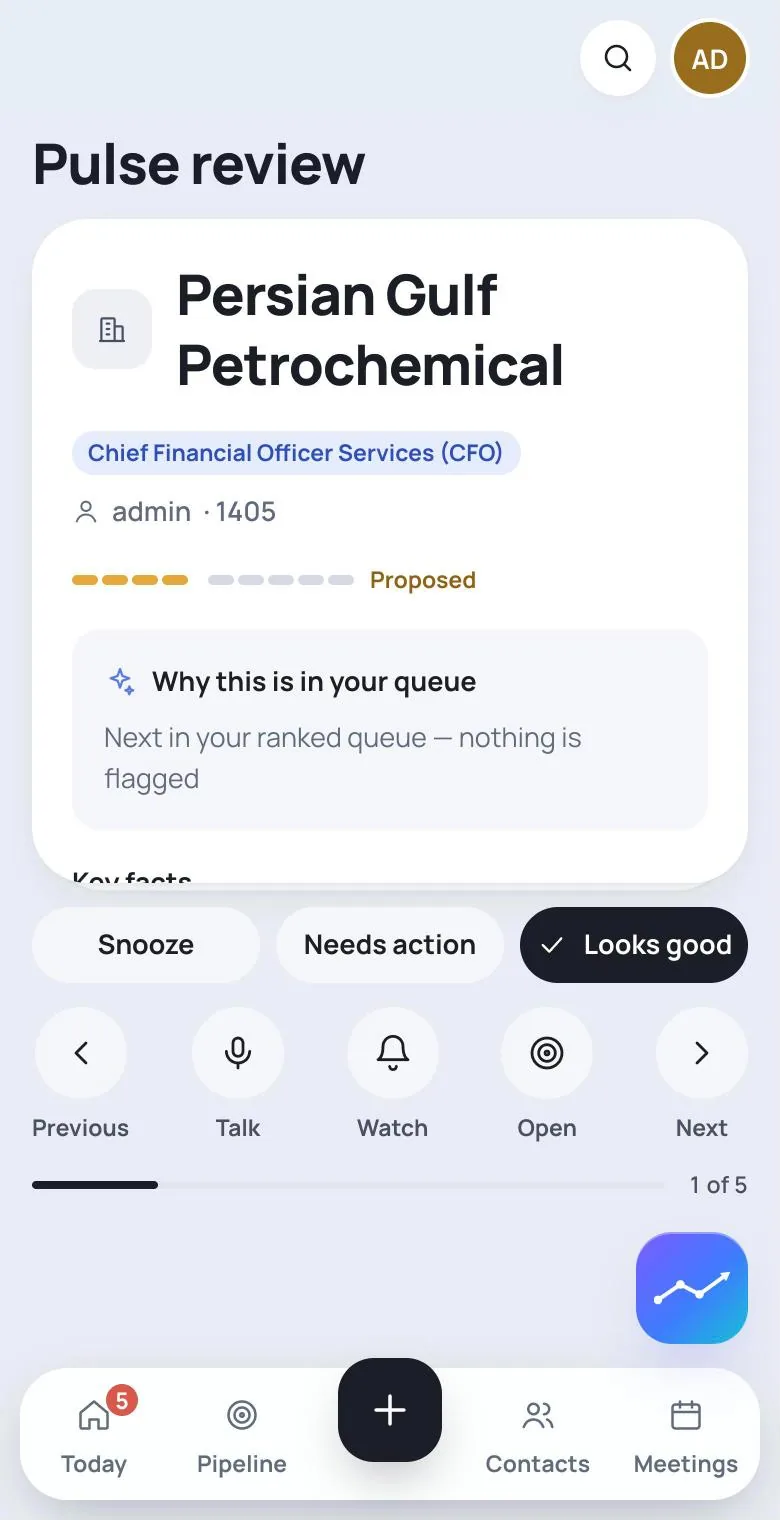
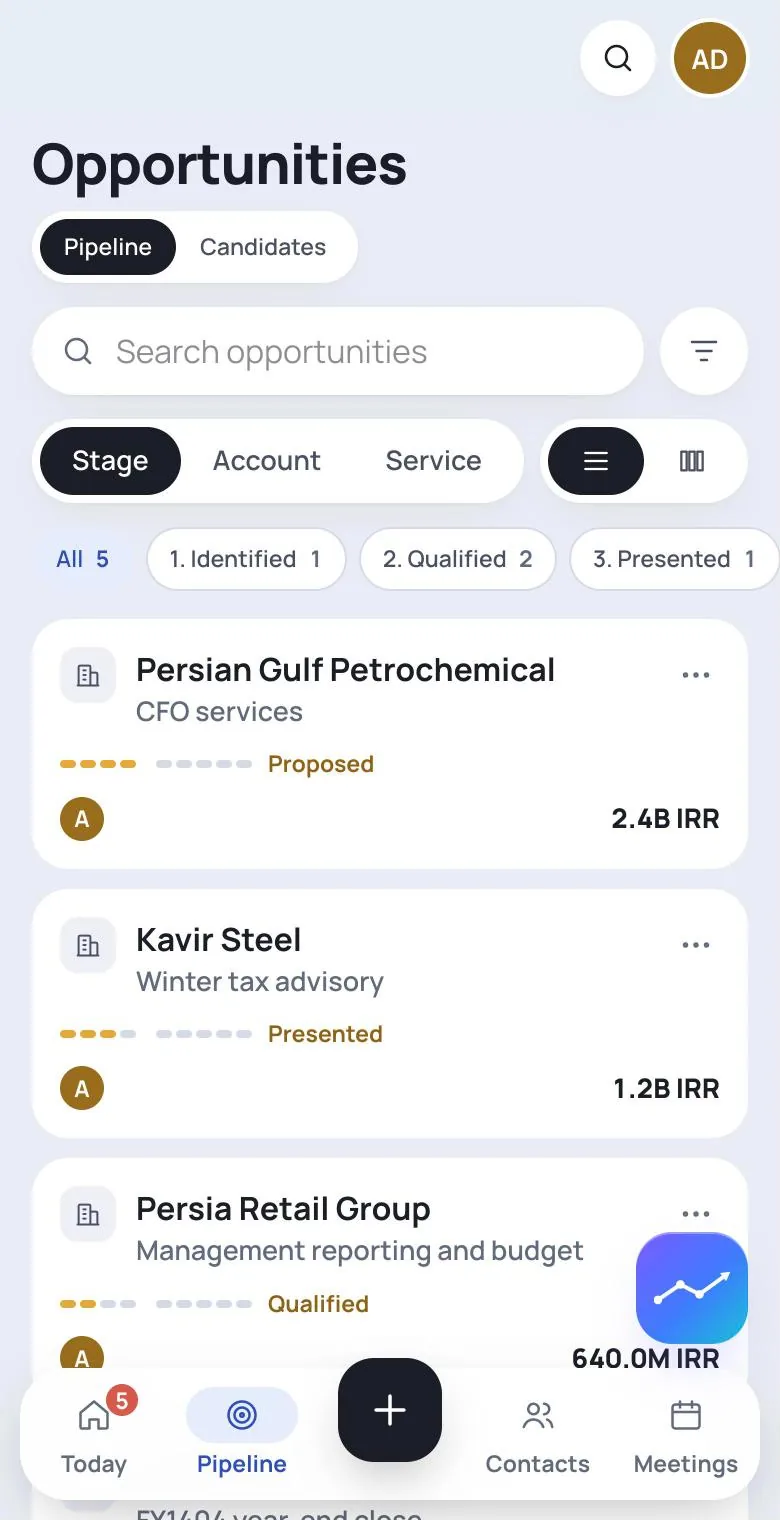
What an opportunity is
Work you are chasing, with everything a seller needs on it
An opportunity has its own table and an engagement has its own. Until the deal closes, you are here.
Four stages, each by its name
Identified, qualified, presented, proposed. The stage bar names every stage, not only the current one; a firm may rename the labels, while numbers and order stay fixed.
An estimated fee, and a probability a person types
The figures are typed by someone and the system invents none. Funnel estimates and signed contract values are two separate blocks and are never added together.
Contacts, with their buying roles
Who decides, who signs, who referred. The service's sales manager lands on the opportunity as soon as the service is set, and can be replaced afterwards.
Each stage carries its own playbook
An ordered list of what to do at this stage, with a template to send or the name of a document to ask the client for. Written once in the catalogue; every open opportunity reads that same live list.
Everything sent is on the record
Which document, to whom, on which day. The record has no edit and no delete; a correction is a new line, and both stay.
Win, lose, reopen
Winning creates the engagement and leaves the opportunity standing with its documents, conversation and team. Losing asks for a reason; reopening is possible. The win sheet asks for the contract value and guesses nothing.
The board
One board, and two questions above it: which work, and whose
Service categories sit across the top as short badges the firm writes itself, and filter with one tap. Choose Account, Contact or Service line and the board's columns become those — every deal passing through one person, under their name.
Clicking a card opens the full deal page in a side panel; the board keeps its filters and its scroll. On a phone the same panel is a bottom sheet.
- Funnel, win rate and stage history on the panel itself
- A timeline shows when each deal is expected to close, and which ones carry no date yet
- Filters live in the page's address; send a narrowed list to a colleague
- Closed work, dimmed, in the stage it was closed from
Proposal sent
Pars Petrochemical
Financial due diligence
4.8 B T
Alborz Foods
Valuation
1.2 B T
Fieldwork
Kavir Steel
FP&A retainer
320 M T / mo
Reporting
Sepehr Logistics
Statement spreading
180 M T
nobody dragged the card — Tuesday's meeting moved it
The same working surface
An opportunity has what an engagement has
A data room, a working feed and the stage surface — the same components, the same width, the same header. Notes, decisions and tasks are written on the opportunity, and pre-contract documents live there too.
Moving between stages is free. The server says what on the playbook is undone and which document has not arrived, but it never blocks the move; the product does not decide on the firm's behalf.
- Moving back asks for a reason and records it
- A closed opportunity stays frozen until it is reopened
- The client-ask checklist, grouped by stage
Week of 21 Tir — 3 open, 2 done
- Send the revised QoE bridge to ParsSara
- Return the signed engagement letterMr Rezaeiclient
- Chase 1402 audited statementsReza
- Validate pages 30–48 of the tax fileYou
- Book the Alborz management callYou
the client's own CFO can owe a step — no login needed
Campaigns
A campaign is a list of your own contacts
Each campaign has its own stages, and its targets are contacts and organisations already in the directory; the target list is built by industry, by the kind of contact a company has, or from named organisations.
Follow-ups are tasks on the contact's own page that also show in the campaign and on the day's agenda. A target that responds goes through the ordinary opportunity door, and the campaign follows what became of it — engagement, closed or deleted — per currency.
- A target is an existing contact or organisation; a campaign creates none
- A follow-up is a task; it appears on its owner's agenda
- Conversion is the ordinary opportunity door, not a separate one
- Sara MohammadiTuesday, 14:02Voice note
Site visit. Mr Rezaei said next year's budget is settled by the end of Mordad and they won't decide anything before then.
Task created: Follow up on budget — Sara Mohammadi
said on the drive back — filed before the office
- Amir KazemiMonday, 09:30
The 1403 statements arrived. Scanned, and the quality is poor.
About opportunities
Can the stages be changed?
The names, yes — per service or per category. Numbers, order and meaning stay fixed, so every chart and funnel remains comparable.If a stage's playbook is unfinished, is the move blocked?
No. The server says what is missing, on the step and on the card, but never refuses the move. Moving back asks for a reason and records it.Can a sendout record be corrected?
With a new line. The previous line stays, because the record of what was sent has to remain what it was.What happens when an opportunity is won?
The engagement is created and the opportunity stays where it was, with its documents, conversation and team. The win sheet asks you for the contract value; the earlier estimate does not become the contract by itself.