Weekly pipeline
Work gets lost between two people
Feeds, transcribed voice notes, and actions that each carry an owner's name.
The parts
A rhythm, not a reporting burden
Voice capture
Record on the phone as you leave the client's office. Transcription runs on a worker and lands in the feed as text you can search.
Feeds with threads
Client, engagement and contact feeds with replies and cross-posting, so context sits where the next person will look for it.
Meetings write into the feeds themselves
What was said in a meeting lands in that client's and that engagement's feed. The week does not have to be reconstructed on Friday; it was written as it happened.
Actions with an owner
Every action has someone's name on it and one gesture to complete: a tick that can be untucked. Done items stay visible.
A ranked attention feed
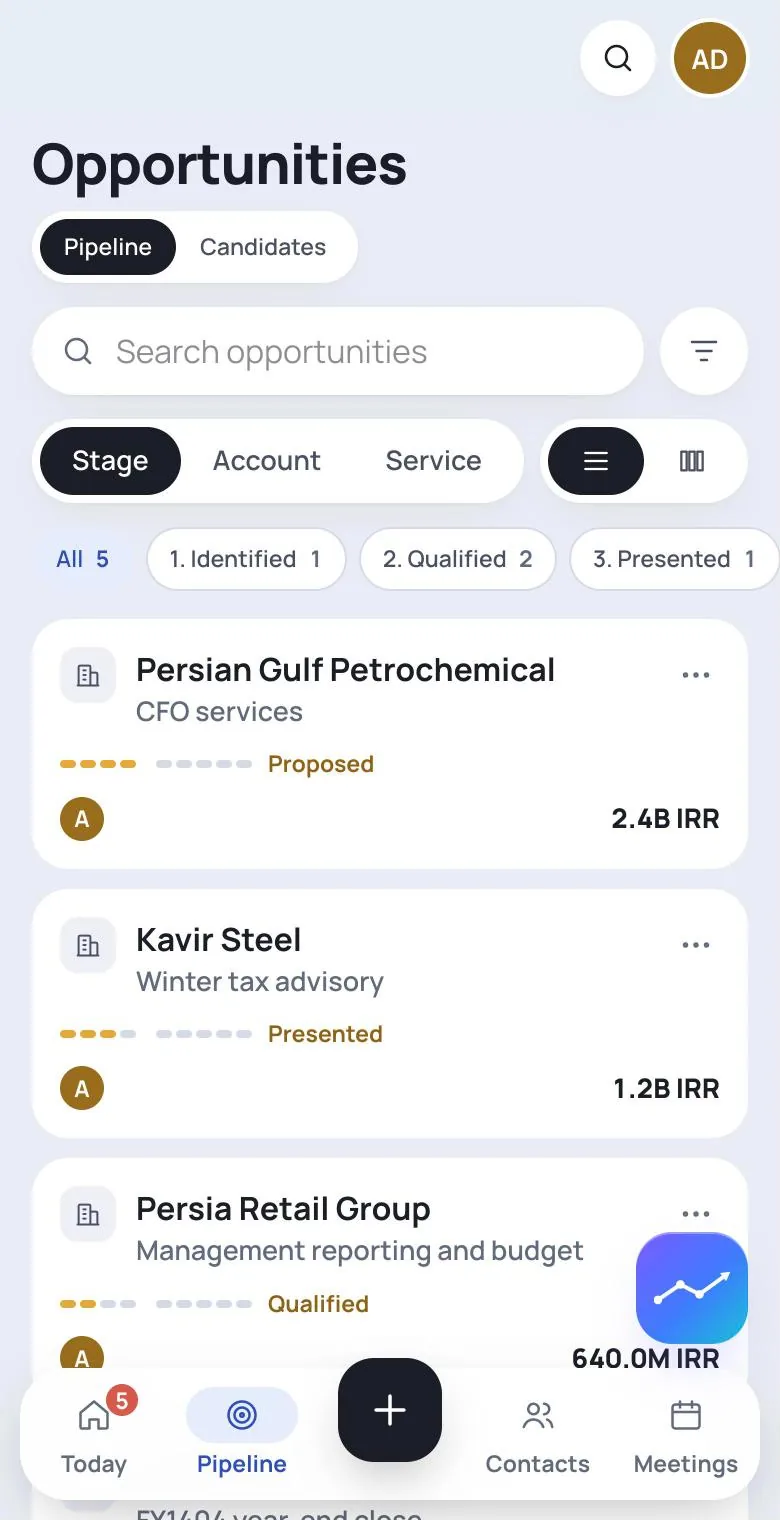
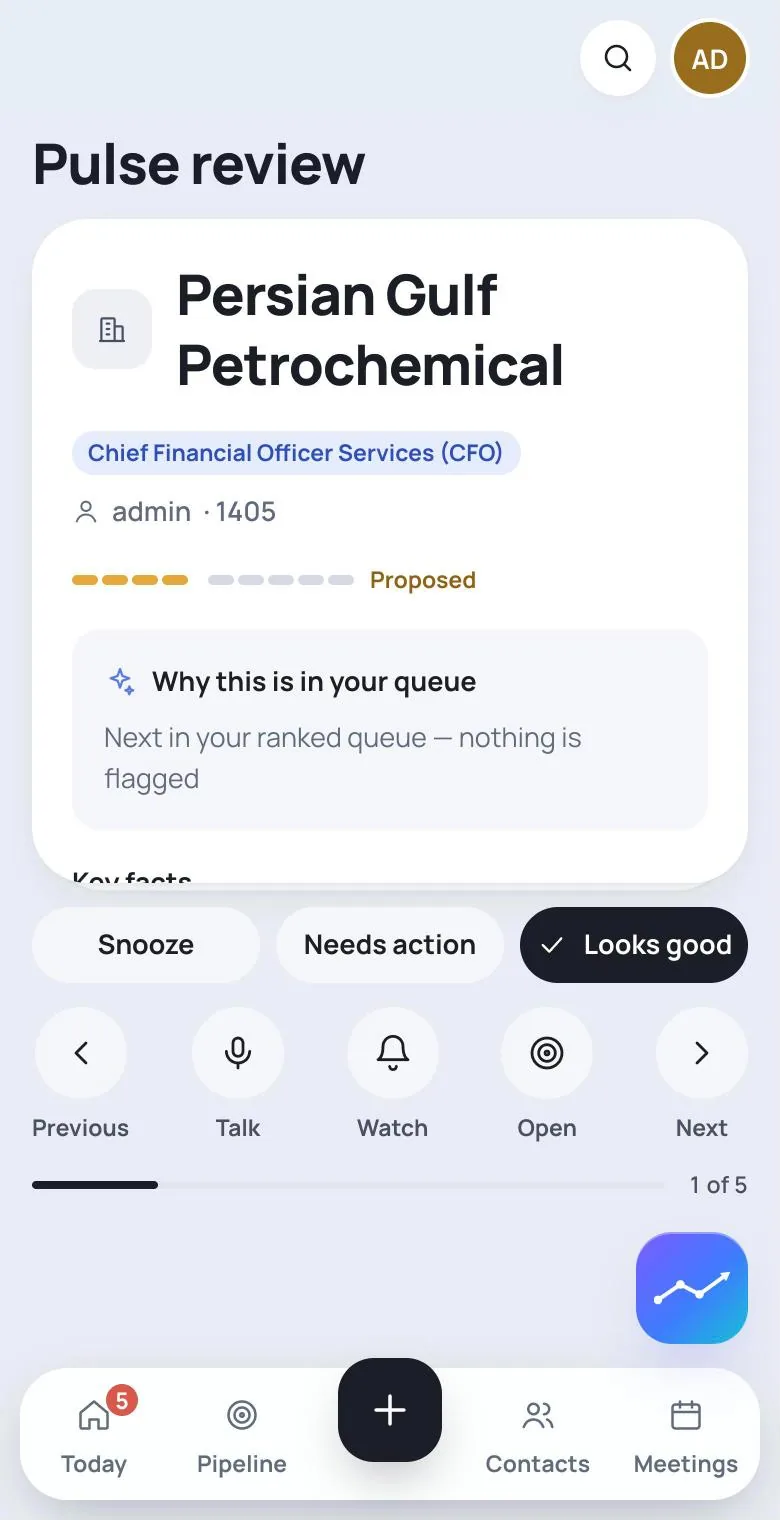
Engagements ranked per viewer by weighted activity and stage kind, with a little deterministic exploration so quiet work resurfaces.
The Work page
The weekly call runs from the screen instead of from someone's notes: this week across every feed, open actions, overdue items.
My work
One page that answers "what is mine this week?"
Actions can be filtered to you, to a colleague, or to the unassigned bucket that every firm accumulates and nobody looks at.
The checklist is deliberately narrow: tick, untick, reassign. Richer triage is a roadmap item rather than a half-built workflow.
- Mine, someone else's, or unassigned
- Overdue and postponed handled explicitly
- Ticks are reversible — no lost item because of a mis-tap
- The same actions appear on the engagement and in the meeting
Week of 21 Tir — 3 open, 2 done
- Send the revised QoE bridge to ParsSara
- Return the signed engagement letterMr Rezaeiclient
- Chase 1402 audited statementsReza
- Validate pages 30–48 of the tax fileYou
- Book the Alborz management callYou
the client's own CFO can owe a step — no login needed
A week in the system
How the loop closes
During the week
Notes and voice memos land in the feed of the client or engagement they belong to.
Meetings, in the same place
Any meeting you record writes into that client's and that engagement's feed. The week is written as it happens, not afterwards.
An action when it really is one
A task is made by marking a note — not automatically from every sentence. Each carries an owner and a due week.
The Work page
The weekly call runs off the stream of every feed: what shipped, what slipped, who owns what next.
About the weekly rhythm
Does voice transcription need internet access?
It needs whichever transcription endpoint you configure. In an on-premises deployment that can be a model inside your network; without any endpoint configured, voice notes are still recorded and stored, just not transcribed.What if we already run a weekly meeting from a spreadsheet?
Most teams do. The switch is usually one service line for one month: the feed replaces the spreadsheet's comment column, and the actions replace its owner column.Can a client see the feed?
No. Feeds are internal. Client-facing sharing is deliberately not built rather than half-built.
See it read your own document
Bring one file you already know well. Thirty minutes is enough to tell whether this belongs in your firm.